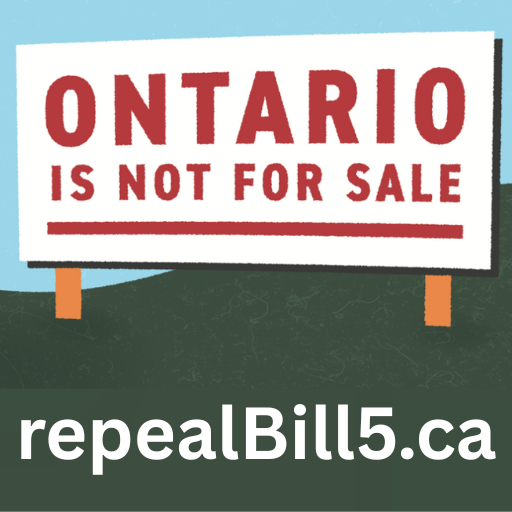
Make no mistake: our democracy is threatened by Ontario Bill 5
Submitted by Sheila Clarke, an ecologist, educator and passionate advocate for the environment, and for an equitable and just society – and for today and for future generations.
In Canada, we take pride in our legal system. We describe our society as based in law. In theory, our laws are consistent; they protect everyone and they apply to everyone. This is particularly important with regard to individual rights and democracy. We are a Parliamentary Democracy which means we elect our representatives by the beliefs and the philosophies they hold. The head of state is a member of parliament, in place at the pleasure of his or her party members, and the voting public which has elected that party. This structure is in place federally, and provincially. Above all, and surrounding us all, is the importance of the Legal system. We are all subject to the law.
The law has taken an interesting turn. In recent years, new laws dealing with a particular topic came before the Legislature after a relatively lengthy period of research and public input, ranging from professional and scientific groups to individual citizens. The final products of these processes were voted into laws by which we are governed.
Ontario Bill 5 has areas of serious concern, as noted in this series of Op Eds, especially Indigenous Rights and Endangered Species; those are all represented by groups. Another voice that struggles to be heard is the individual- the citizen, the taxpayer. There are two areas of Bill 5 that affect the individual.
Previously the government had removed right of consultation on any land use and claims from any other than immediate neighbours to the properties in question. Other interested parties in a particular land use such as a Conservation Authority, a municipal planning representative, or a near neighbour or community could not be represented. However, the individual neighbour property owner still retained the right of consultation. (Bill 23, 2022)
A new protocol called “Permit by Registration” removes that right. If a project provides an action plan, and assures the government that it will follow all legal requirements, the project agent simply fills out an online form, signs it, and may begin construction. Anyone adjacent to that property has no recourse to point out concerns about the impact the project will have on their land. There is no mandate for consultation, as in previous protocols (Permit by Approval). Inspections will follow, but with the new interpretations in Bill 5 of environmental laws (Op Ed: Endangered Species) once the damage is done, there is no possibility of restoring that environment.
The other element of Bill 5 that concerns individuals is that of Special Economic Zones (SEZs). They are remarkable definitions of areas that the government wants to develop for economic significance or strategic importance to the economy- in the estimation of a very small cohort indeed. The persons determining the importance of a Special Economic Zone will be the Lieutenant Governor in Council (Cabinet), and specifically the Minister of Economic Development, Job Creation and Trade: This Minister has the power to designate a specific project or class of projects as a “designated project,” if it meets the criteria established in the regulations.
How does this impact the individual? Through three potential paths: The first is ownership of property. There are legal firms that specialize in support of those whose property is expropriated by a government for projects. Those law firms are watching SEZs very carefully.
Secondly, some projects will affect the public health. Scientists and Indigenous peoples have noted the presence of huge deposits of methane sequestered in the peat bogs of the Ring of Fire. Methane is 80 times more powerful than Carbon Dioxide as a greenhouse gas. With the decisions being made to seize particular lands without regard to the environmental consequences, we hold every individual at ransom with air quality, forest fires and massive storms, to which adaptation is simply impossible.
And thirdly, there is a remarkably unique interpretation within SEZs. We are a country of laws. The laws apply to us all- except in SEZs, according to Bill 5. The mandate to set aside laws that interfere with the expedient development under consideration may be set aside by, again, the Lieutenant Governor in Council (Cabinet), and specifically the Minister of Economic Development, Job Creation and Trade.
The government is assuring us that labour relations will be important in company operations in SEZs, that environmental laws (as altered by Bill 5), and health and safety laws will be respected. That is not written in Bill 5, and rests within the Cabinet. The individuals working in SEZs will have no recourse if they are harmed. The Bill ensures that the government cannot be held responsible for harms caused by Bill 5 (Schedules 1, 7, 9 and 5).
Is the individual at risk with Bill 5? Yes, but more to the point, Democracy is. Our system of government is based up elections whereby we entrust our lives and livelihoods to the keeping of a government defined by law. It is deeply concerning that laws would be devised to avoid the tradition of laws that protect the individual- and our surroundings- our property, our health, and the nature we love.